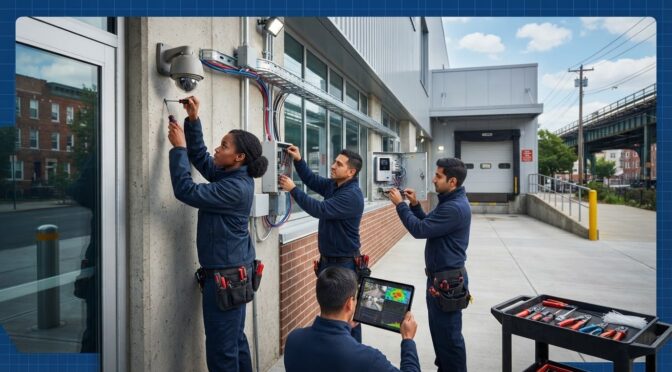
The clearest 4K lens in the world won’t protect your property if the low-voltage backbone behind it fails. Most commercial surveillance setups don’t collapse because of camera sensors; they fail due to unstable wireless links, improper power delivery, and exposed wiring. When planning a business security camera installation Queens facility owners quickly discover that durable infrastructure matters far more than flashy marketing specs.
You already know the daily friction of managing facility security across our borough. Between monitoring active loading bays in Maspeth, resolving disputed delivery claims on busy commercial corridors, and squinting at washed-out night footage, you need equipment that performs without constant troubleshooting. This guide helps you make the right investment the first time. You’ll learn how to match commercial IP hardware to your property’s specific physical layout, satisfy local building code requirements, and integrate cameras seamlessly with access control and video intercoms. Below, we break down the technical specifications and structural requirements that guarantee a reliable, long-term deployment.
Key Takeaways
- Identify facility-specific vulnerabilities across Queens commercial properties to select the right balance of exterior perimeter deterrence and interior monitoring.
- Select commercial optical hardware equipped with True Wide Dynamic Range and ruggedized housings to eliminate entryway glare and resist physical tampering.
- Ensure your business security camera installation Queens project relies on code-compliant plenum cabling and balanced power delivery rather than vulnerable wireless connections.
- Unify CCTV surveillance systems with electronic access control, magnetic locks, and video intercoms to verify credentials and link video records directly to door events.
- Review local building requirements and New York privacy regulations before deployment to confirm compliant camera placement and legal recording practices.
Why Commercial Properties in Queens Require Dedicated Business Security Cameras
Operating a commercial facility in Queens presents environmental challenges that off-the-shelf consumer gear cannot handle. From heavy multi-axle freight traffic rattling brick masonry to dense pedestrian crowds filtering past storefront entryways, commercial environments demand continuous reliability. Commercial surveillance is not simply about passive observation; it delivers verifiable visual evidence, discourages perimeter trespassing, and establishes accountability across loading zones and interior work areas.
Urban density magnifies property risk. When high foot traffic overlaps with municipal bus corridors and alleyway delivery routes, false slip-and-fall claims or package disputes occur regularly. Commercial property insurance underwriters routinely review these exposure profiles. Many carriers now require hardwired, continuous recording systems before approving active liability coverage, preferring modern closed-circuit television (CCTV) architecture over consumer-grade equipment that relies on unpredictable cloud streaming.
Addressing Queens Commercial Vulnerabilities
Different industrial pockets face very specific daily stresses:
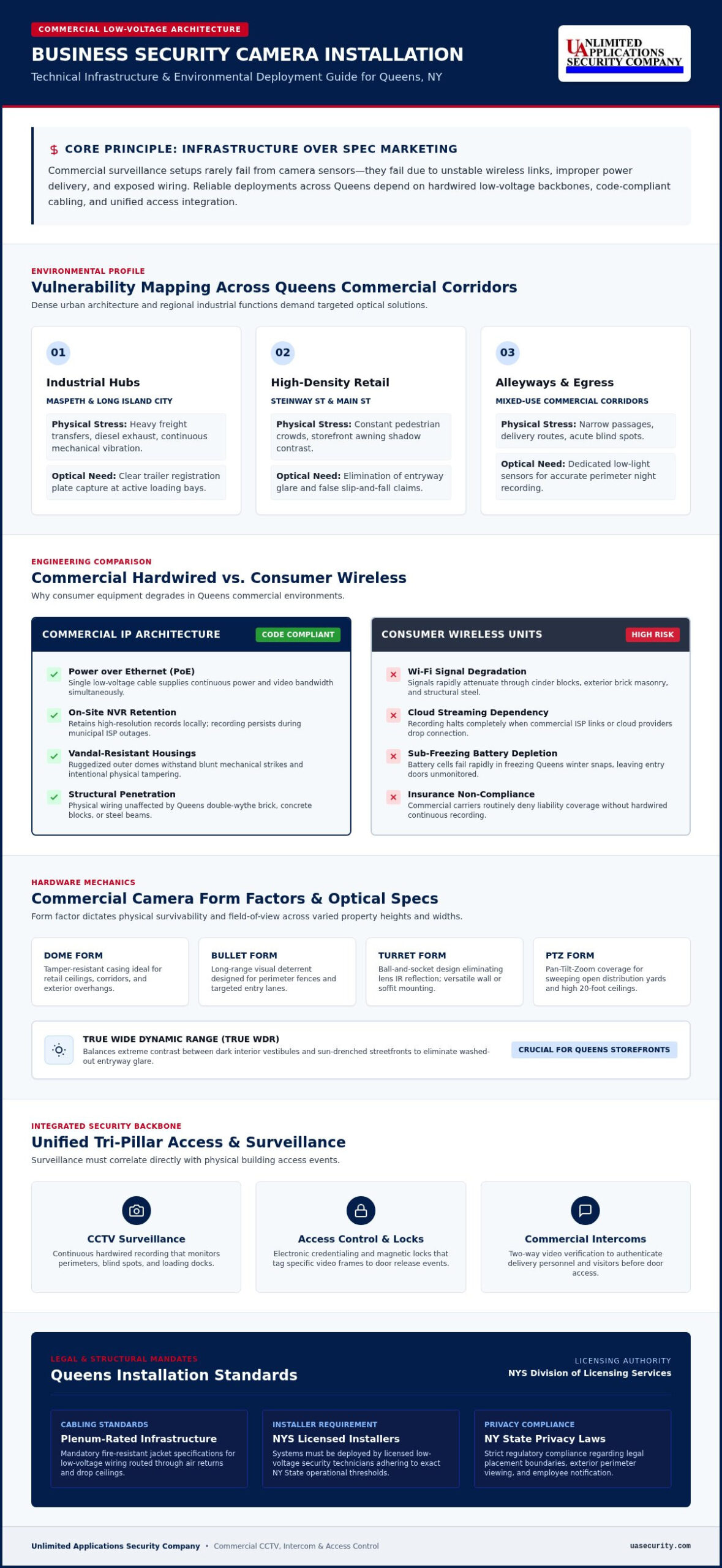
- Industrial Distribution Hubs: Warehouses along Maspeth and Long Island City manage dozens of daily freight transfers. Securing loading docks requires optical sensors that capture clear trailer registration numbers despite constant diesel exhaust and mechanical vibration.
- High-Density Corridors: Retail storefronts along Steinway Street in Astoria or Main Street in Flushing deal with constant foot traffic. Optical setups here must eliminate entryway shadowing caused by exterior awnings.
- Rear Alleyways and Egress Doors: Narrow passage routes behind mixed-use properties create persistent blind spots. These perimeter access points require dedicated low-light sensors to document nighttime activity accurately.
Commercial Hardwired Systems vs Consumer Wireless Cameras
Consumer wireless cameras frequently fail in urban commercial buildings. Dense structural elements like Queens double-wythe brick, concrete cinder blocks, and structural steel degrade Wi-Fi signals quickly. Battery-powered units shut down during sub-freezing winter snaps, leaving your entryways unmonitored. When businesses invest in a professional business security camera installation Queens facility managers can depend on, they bypass these vulnerabilities entirely.
Commercial IP setups rely on hardwired Power over Ethernet (PoE). A single dedicated low-voltage cable supplies continuous operating power and stable video bandwidth simultaneously. On-site network video recorders retain high-resolution footage locally, ensuring recordings continue uninterrupted even during broad municipal ISP service outages. Heavy-duty vandal-resistant dome housings protect external lenses against blunt mechanical strikes and intentional tampering, delivering the physical durability necessary for harsh urban service.
Essential Camera Hardware and Specifications for Queens Businesses
Selecting commercial optical hardware requires matching camera mechanics to your building’s architectural layout. Converted industrial lofts in Long Island City with 20-foot ceilings present completely different imaging demands than a narrow, street-level retail boutique in Sunnyside. Installing mismatched lenses often produces blurry digital blowups that fail to capture identifiable features when an incident occurs.
Professional technicians evaluate physical environments before mounting equipment. Under New York State security installer licensing regulations, commercial systems must be designed and installed by licensed professionals who understand these exact low-voltage and operational thresholds. Working with a qualified partner like Unlimited Applications Security Company ensures your surveillance hardware matches both municipal requirements and facility layout needs.
Form Factors: Dome, Bullet, Turret, and PTZ Cameras
Form factor dictates physical survivability and field of view across varied commercial spaces:
- Vandal-Proof Domes: Enclosed in impact-rated polycarbonates, dome cameras offer discreet surveillance for customer service areas and office corridors while concealing lens orientation from view.
- Bullet Cameras: Featuring extended housings and prominent profiles, bullet units establish an active visual presence along perimeter fences and alley access paths.
- Turret (Eyeball) Cameras: By separating the optical lens from the infrared illuminators, turret designs eliminate internal glass bounce-back, excelling in damp basements and dusty storage facilities.
- Pan-Tilt-Zoom (PTZ) Units: Motorized mechanics enable operators to pan across wide areas, making them ideal for Maspeth fleet yards and multi-bay parking facilities.
Core Technical Specifications to Demand
Resolution alone does not guarantee usable evidence. For an effective business security camera installation Queens business operators should require these baseline parameters:
- 4K or 4-Megapixel Optical Sensors: Provide adequate pixel density to identify facial traits, inventory tags, and license numbers across wide fields of view.
- True Wide Dynamic Range (120dB+): Balances harsh contrast when intense afternoon light streams through storefront glass, preventing subjects in front of windows from turning into dark silhouettes.
- IP66 or IP67 Weatherproof Ratings: Protects internal circuit boards against driving rain, Atlantic coastal humidity, and seasonal freezes.
- H.265 Smart Codec Encoding: Compresses high-bitrate video streams to preserve network bandwidth and cut digital storage drive consumption roughly in half.
Evaluating Video Storage, Network Infrastructure, and Cabling Requirements
Durable surveillance performance relies entirely on the cabling infrastructure behind the cameras. While high-resolution optics capture the scene, insufficient data throughput or unstable voltage causes dropped frames and recorder disconnections. Aligning physical installation standards with the CISA physical security framework ensures that low-voltage delivery remains fully resilient against physical tampering, environmental deterioration, and commercial utility failures.
Storage calculations must balance operational retention goals with local regulatory requirements. Commercial facilities typically maintain 30 to 90 days of continuous recording to support internal audits and liability reviews. Without proper codec configuration, multi-camera 4K arrays quickly saturate digital storage arrays and congest business data subnets.
On-Premises NVR vs Cloud Video Surveillance
Choosing an architecture dictates your long-term maintenance approach and operational costs:
- On-Premises Network Video Recorders: NVR appliances store uncompressed, full-frame footage directly on dedicated enterprise hard drives on-site. This model eliminates recurring monthly cloud storage fees and keeps internal footage accessible even if your exterior ISP link drops.
- Pure Cloud Architectures: Offload recorder hardware management off-site, but they consume continuous upload bandwidth and require ongoing subscription fees for every active camera.
- Hybrid Systems: Offer a practical middle ground. They record continuous primary streams to local on-site storage while syncing bookmarked motion triggers and alarm events securely off-site for rapid remote review.
Structured Cabling and Electrical Infrastructure
Planning a reliable business security camera installation Queens facility owners can trust requires strict attention to physical pathways:
- Pure Copper Category 6 Cabling: Solid copper conductors maintain strict Power over Ethernet voltage levels over runs approaching 300 feet, preventing camera reboots when infrared illuminators draw peak wattage at night. Copper-clad aluminum substitutes should never be used.
- Rigid and EMT Conduit Pathways: Exposed basements, exterior masonry walls, and delivery docks across industrial Queens require metallic conduit to shield low-voltage wiring from rodent chewing, mechanical impact, and intentional cutting.
- Uninterruptible Power Supply (UPS) Protection: Battery backup hardware isolates your network switches and NVR from electrical surges, preserving recording integrity during localized brownouts.
- Unified Pathway Planning: Property managers can coordinate shared riser pathways across multiple systems; reviewing a guide to professional intercom installation demonstrates how low-voltage data lines can be planned alongside entry systems for cleaner conduit routing.
Integrating CCTV Surveillance with Access Control and Commercial Intercoms
Standalone surveillance cameras capture evidence after an event occurs, but true facility security requires preventing unauthorized physical entry in real time. Isolating video feeds from door hardware creates operational blind spots. When overhead optics, door controllers, and entrance stations communicate across a unified infrastructure, your entry perimeter transforms from a passive monitoring point into an active physical barrier.
Linking these components eliminates blind door releases. In multi-tenant commercial spaces or busy corporate offices across Queens, staff frequently buzz visitors through without visual verification. Synchronizing entrance cameras with door-release relays ensures that no latch trips until front-desk staff or automated controllers verify the visitor’s face on screen.
Visual Verification at Commercial Entry Points
Positioning cameras at eye level captures clear, unmasked facial images before a visitor activates a call button. Integrating this video feed directly with entry master stations allows staff to inspect credentials and body language instantly:
- Dedicated Intercom Systems: Professional CCTV installations integrate cleanly with commercial hardware from established manufacturers like Aiphone, Comelit, and Siedle, displaying auxiliary overhead angles alongside intercom sub-station video.
- Hardware Health Checks: Cameras cannot compensate for malfunctioning physical hardware; scheduling professional intercom repair NYC resolves faulty relays and worn audio panels before overlaying new optical sensors.
Coordinating Locking Hardware with Video Audit Trails
A comprehensive business security camera installation Queens properties require goes beyond simple video feeds. It ties recording bookmarks directly to physical door transitions. Wiring dry contacts between locking hardware and camera sensor inputs creates an accurate, searchable record of every physical entry event:
- Electric Strikes and Magnetic Locks: Trigger instantaneous high-frame-rate recording the moment an electric strike or magnetic lock receives an authorized unlock signal, logging the exact user credential against high-definition video.
- Forced-Door and Door-Prop Alarms: Automatically pivot PTZ units or switch monitor views to rear service exits if a latch remains unseated longer than a pre-set threshold.
- Egress Code Compliance: Maintain fail-safe release protocols so all magnetic locks drop immediately upon fire alarm actuation or local push-to-exit bar depression, satisfying New York City life-safety mandates.
If your current facility relies on disconnected hardware, contact Unlimited Applications Security Company to engineer an integrated commercial surveillance and access control system.
Planning Your Queens Business Installation: Regulations, Logistics, and Next Steps
A successful commercial deployment begins with methodical property analysis, not hasty hardware purchases. Mounting cameras without calculating optical focal lengths or checking local statutes leads to compromised coverage and expensive revisions. When executing a business security camera installation Queens property owners must evaluate regulatory compliance, structural pathways, and physical mounting logistics before pulling the first line of cable.
New York Compliance and Workplace Privacy Best Practices
Operating commercial surveillance in New York carries specific statutory responsibilities. Installers must position lenses strictly within common work areas and operational spaces while observing legal boundaries:
- Restricted Privacy Areas: Camera lenses must never point into employee restrooms, locker facilities, or designated changing lounges.
- Audio Recording Restrictions: Unattended audio capture on commercial security cameras presents significant legal liabilities under New York wiretapping statutes. Microphones should remain deactivated by default in public retail areas and mixed-use customer spaces.
- Conspicuous Signage: Mount clear notification placards at primary customer entrances, staff checkpoints, and freight delivery bays to establish transparent disclosure of video monitoring.
Executing the Professional Site Assessment
Precision layout planning requires an on-site physical survey by an experienced technician who understands Queens building construction. Walking the property perimeter establishes exact hardware requirements:
- Optical Mapping: Technicians calculate lens focal lengths and mounting elevations to eliminate blind spots around exterior gates, customer counters, and alleyway egress doors.
- Pathway Diagnostics: Inspecting electrical panels, low-voltage riser shafts, and server closet capacity reveals the most efficient routing for protective conduit and rack installations.
- Network Isolation: Setting up dedicated physical switches or isolated subnets prevents camera data feeds from competing with operational business traffic.
Partnering with a seasoned local integrator provides dependable initial installation and responsive on-site troubleshooting whenever adjustments are required. Schedule a site consultation with Unlimited Applications Security Company to design a fully compliant, high-definition surveillance setup engineered for your facility.
Build a Resilient Commercial Security Infrastructure in Queens
A commercial surveillance system is only as dependable as the physical cabling, optical engineering, and door hardware supporting it. Prioritizing solid copper low-voltage infrastructure, True WDR optics, and coordinated integration with locking hardware ensures your investment delivers continuous protection instead of constant troubleshooting. When planning a business security camera installation Queens facility managers benefit most from unified hardware tailored directly to their building’s footprint.
Unlimited Applications Security Company brings over 30 years of field-tested security integration experience to New York City commercial properties. Our technicians solve tough urban structural challenges daily, seamlessly connecting CCTV surveillance systems with commercial access control, electric strikes, and video intercoms. Don’t leave your facility’s physical perimeter to chance. Schedule a commercial security assessment with Unlimited Applications Security Company to safeguard your property with reliable, code-compliant protection built for the long haul.
Frequently Asked Questions
Do Queens businesses need permits to install security cameras?
Low-voltage cabling under 50 volts generally does not require a Department of Buildings electrical permit in New York City. However, filings are required if the work involves structural penetrations through fire-rated assemblies, historic facade alterations, or direct electrical ties to municipal fire alarm release hardware. Technicians check these specific property parameters during an initial layout survey.
How long must commercial security camera footage be stored in New York?
General commercial operations are not bound by a single state storage retention mandate, though 30 to 90 days remains standard for internal accountability. Certain regulated business sectors, such as cannabis dispensaries or municipal contractors, must adhere to strict state retention rules. Hard drive capacity should always match your specific industry audit cycle.
Can commercial security cameras legally record audio on Queens business premises?
Recording audio on unattended commercial cameras is illegal under New York wiretapping statutes without consent from at least one party involved in the conversation. Violations constitute criminal eavesdropping. Best practice for commercial properties across Queens is to disable onboard microphones permanently in customer areas, retail floors, and exterior spaces.
What is the difference between IP cameras and legacy analog CCTV systems?
IP cameras process and encode digital video at the camera head, transmitting high-resolution data and operating power across a single Category 6 Ethernet cable. Legacy analog systems rely on older coaxial lines with separate power feeds, which limits image clarity and drops signal over long distances. Modern digital hardware also supports higher resolutions and edge analytics.
Can exterior security cameras withstand harsh Queens winter weather conditions?
Exterior commercial cameras withstand freezing temperatures and driving coastal precipitation when built with IP66 or IP67 weatherproof ratings. Metal housings protect internal optical sensors from frost buildup, seasonal temperature drops, and high winds off Jamaica Bay or the East River. Proper exterior cable seals prevent moisture intrusion into delicate Ethernet termination jacks.
Can business security cameras integrate with existing intercom and buzzer systems?
Yes, modern CCTV surveillance systems integrate directly with commercial entry systems and door release controls. When planning a business security camera installation Queens facility operators frequently connect overhead optical feeds with intercom stations from manufacturers like Aiphone, Comelit, and Siedle. This setup triggers automatic video recording whenever visitors request entry through electric strikes or magnetic locks.
How do commercial cameras handle low-light or unlit industrial areas overnight?
Commercial cameras use high-output infrared illuminators and specialized large-aperture sensors to capture clear video in total darkness. In poorly lit loading docks and alleyways, high-sensitivity optical sensors pull usable exposure from faint ambient street lighting. This prevents digital noise and motion blurring when vehicles or pedestrians move through the frame.