A 1,200-pound magnetic lock sounds like the ultimate defense for an entryway, but raw holding force means very little if the setup fails a fire inspection or traps occupants during an emergency. When evaluating an electric strike vs magnetic lock for your commercial or residential opening, the right choice rarely comes down to brute strength. Instead, the decision hinges on door frame construction, daily traffic flow, and strict life-safety egress codes.
If you’re struggling with latch alignment issues, wondering whether to cut into a metal door jamb, or trying to sort through fail-safe versus fail-secure wiring, you aren’t alone. Securing a perimeter shouldn’t force you into code violations or equipment failures that leave doors unlocked when power drops. We’ll examine the mechanical differences between both systems, mandatory emergency release conditions under model building codes, and the structural installation demands of each device. Here is what you need to know to select the right locking hardware for your facility with total confidence.
Key Takeaways
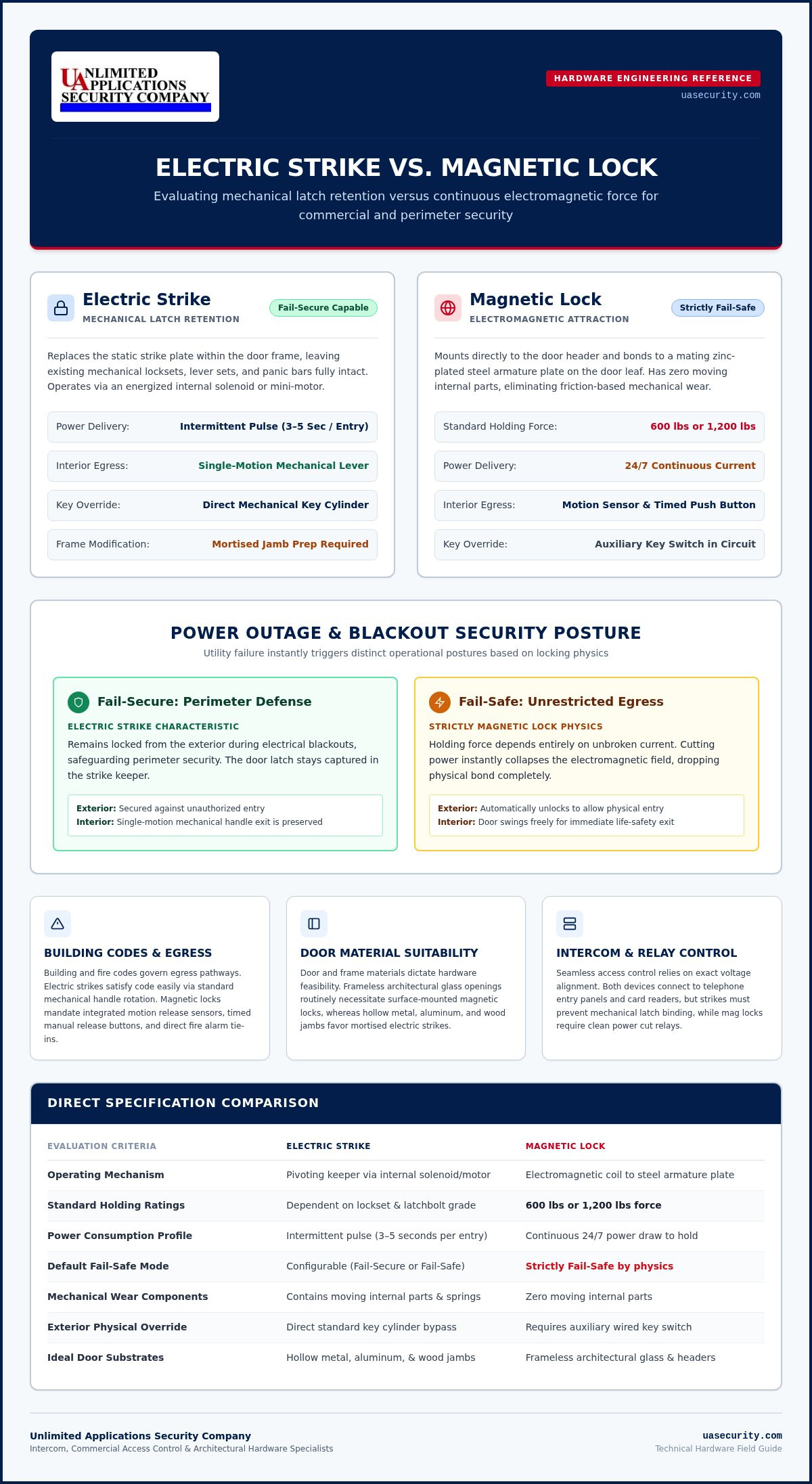
- Deciding between an electric strike vs magnetic lock starts with door mechanics; strikes preserve your existing mechanical lockset and handle, while magnetic locks rely entirely on continuous electromagnetic force.
- Life-safety codes govern egress paths; electric strikes allow standard single-motion mechanical exit from the interior, whereas magnetic locks require integrated motion sensors, timed push buttons, and fire alarm tie-ins to comply with local regulations.
- Power loss behavior dictates security posture; fail-secure electric strikes stay locked from the outside during blackouts, while magnetic locks are strictly fail-safe and drop their hold whenever electrical current interrupts.
- Door material and frame design determine installation practicality; frameless architectural glass openings often necessitate surface-mounted magnetic locks, while hollow metal and wood jambs favor mortised electric strikes.
- Seamless integration with building intercoms, telephone entry panels, and keycard readers requires selecting hardware that matches your system’s power supply and relay triggers without causing latch binding.
Core Differences Between Electric Strikes and Magnetic Locks
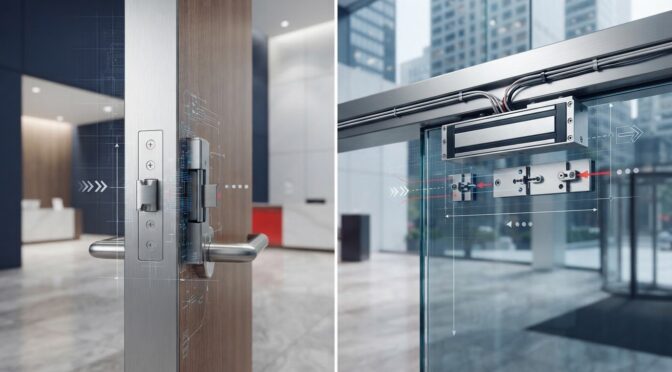
Selecting the right access hardware begins with understanding how each device controls door movement. An electric strike replaces the static strike plate inside the door frame, leaving the mechanical latchbolt and lever set intact. In contrast, an electromagnetic lock mounts directly to the frame header and bonds to a mating armature plate secured on the door leaf.
The operational debate of an electric strike vs magnetic lock comes down to mechanical latch retention versus continuous electromagnetic attraction. Strikes release mechanically through an energized internal solenoid, while magnetic locks rely on unbroken electrical current to maintain physical holding force.
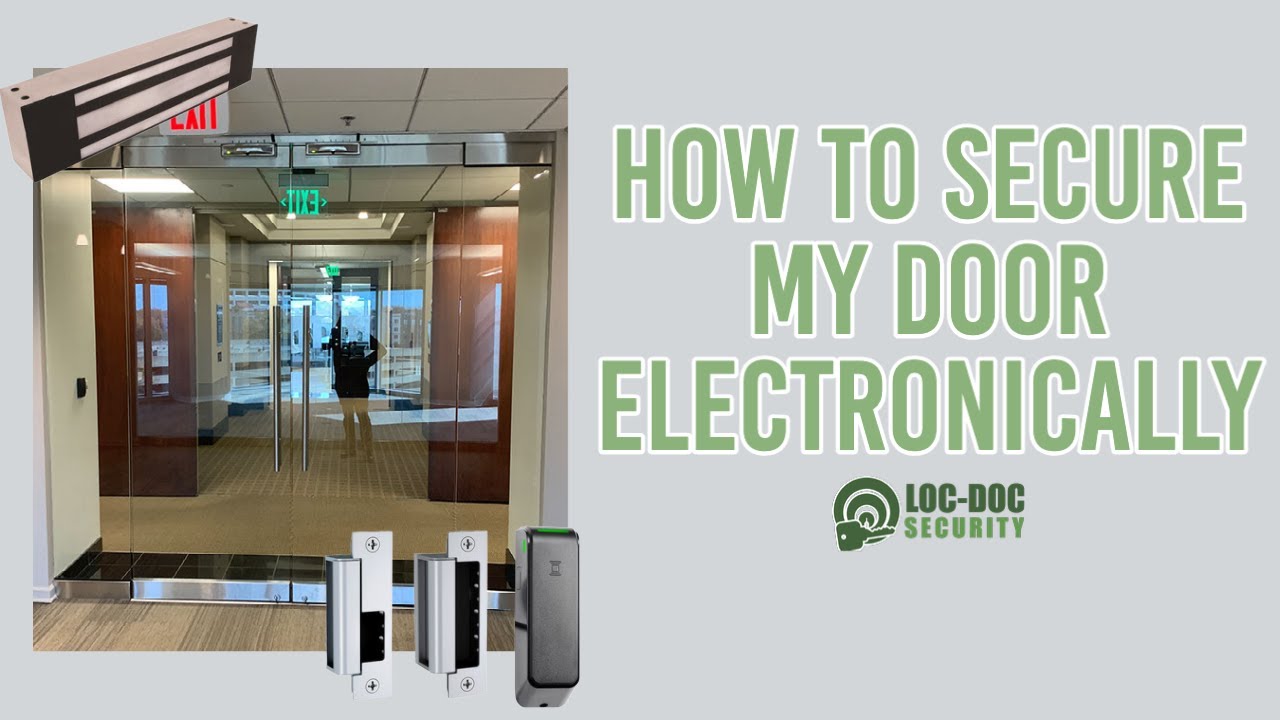
To see how these two locking concepts operate in a field environment, watch this helpful comparison:
How Electric Strikes Work: Mechanics and Keeper Operation
An electric strike utilizes a hinged keeper controlled by an internal solenoid or mini-motor. When triggered by an access control reader or intercom relay, the keeper pivots to let the latchbolt slip free, enabling the user to push or pull the door open without turning the handle. These units pair directly with standard cylindrical locksets, mortise hardware, and exit panic crash bars. Because the physical interior lever remains connected to the latch, occupants retain immediate, single-motion mechanical egress without depending on electronic sensors.
How Magnetic Locks Work: Electromagnetism and Armature Plates
A magnetic lock relies on raw physics rather than latches or pins. The system pairs an electromagnetic coil secured to the frame with a flat, zinc-plated steel armature plate installed on the door leaf. Supplying steady direct current establishes an electromagnetic field that bonds the two components together, producing standard holding force ratings of 600 or 1,200 pounds. Because magnetic locks have zero moving internal parts, they do not experience mechanical friction wear, making them exceptionally durable in high-traffic commercial environments.
Comparison Matrix: Power, Security, and Physical Mounting
Evaluating an electric strike vs magnetic lock requires weighing structural door preparation against operational power delivery:
- Power Consumption: Fail-secure electric strikes use intermittent pulse power, drawing current only for three to five seconds per entry event. Magnetic locks draw continuous power around the clock to remain secured.
- Frame Preparation: Electric strikes require cutting, drilling, and mortising into the hollow metal, aluminum, or wood jamb. Magnetic locks typically surface-mount to the header, leaving the frame interior largely intact.
- Physical Override: Strikes retain exterior mechanical key overrides directly through the existing lock cylinder. Magnetic locks provide no physical key bypass unless an auxiliary manual key switch is wired into the power loop.
Fail-Safe vs. Fail-Secure: Power Loss Behavior and Security Posture
Every electronic opening behaves differently the moment main utility power drops. Fail-safe hardware unlocks automatically whenever electrical current is completely interrupted, prioritizing immediate egress and life safety. Fail-secure hardware stays locked from the exterior during an outage, maintaining perimeter defense while depending on internal door mechanics to let occupants exit.
This fundamental split defines the operational boundary when comparing an electric strike vs magnetic lock. A magnetic lock is strictly fail-safe by the laws of physics. Because holding force depends entirely on an active electromagnetic field, killing power collapses the bond instantly. Electric strikes, however, offer field flexibility. Most commercial grade models can be configured as either fail-secure or fail-safe depending on site security requirements and local code mandates.
Fail-Secure Electric Strikes: Perimeter Security During Outages
Exterior building entrances almost universally mandate fail-secure perimeter protection. If a neighborhood blackout occurs, a fail-secure electric strike keeps the exterior door locked to outside intruders without drawing backup battery power. Inside occupants remain safe because turning the mechanical lever retracts the latchbolt normally, providing unimpeded exit. Outside keyholders can still enter using a physical brass key in the existing lock cylinder, ensuring facilities teams never lose access during severe grid failures.
However, electric strikes can suffer from latch pre-load issues if the door settles. When heavy wind, door warpage, or misaligned hinges push the latch firmly against the strike keeper, the internal solenoid may bind and fail to release. Regular mechanical door inspections prevent this friction before it disables the opening.
Fail-Safe Magnetic Locks: Life Safety and Power Dependency
Because magnetic locks unlock the instant electrical current drops, an unprotected maglock leaves a building completely open during a blackout. Preventing unauthorized entry requires a continuous uninterruptible power supply (UPS) backed by sealed lead-acid batteries. While this battery backup maintains security through short power dips, it introduces life-safety challenges that demand dedicated electronic release loops.
Poorly maintained magnetic locks also run the risk of residual magnetism. Over years of operation, slight residual charges can linger in the steel core, causing the armature plate to stick even after the access control system drops power. High-quality commercial units address this with built-in kick-off springs and inductive suppression diodes to guarantee instantaneous release.
If you’re dealing with door latch alignment problems or need to audit your building’s emergency power configurations, working with the experienced technicians at Unlimited Applications Security Company ensures your hardware satisfies both perimeter protection and local egress standards.
Building Codes, Fire Safety, and Egress Compliance Realities
Life-safety regulations dictate how an entryway must operate during an emergency, regardless of your security goals. Model building codes, including the International Building Code (IBC) and NFPA 101 Life Safety Code, focus heavily on ensuring occupants can exit freely without special knowledge or physical effort. In the debate between an electric strike vs magnetic lock, egress compliance creates the sharpest dividing line between simple installations and complex engineering requirements.
Electric strikes typically pass fire safety inspections with minimal friction. Because the mechanical latchset remains operational, turning the handle or pushing an exit crash bar physically retracts the latchbolt. Magnetic locks, however, rigidly bind the door leaf to the frame using electromagnetic force. If an occupant pushes the door without an active electronic power cut, the door will not budge. Consequently, municipal building codes enforce stringent, multi-device egress requirements whenever a magnetic lock secures an exit pathway.
Single-Motion Egress vs. Maglock Trapping Hazards
Under IBC guidelines, exit doors along an egress path must unlatch with a single mechanical motion. Striking hardware paired with standard commercial lever sets or rim panic devices complies effortlessly. The user pushes the bar, the latch withdraws, and the door opens. Magnetic locks cannot provide physical unlatching on their own. Without redundant power-interrupt devices, a system failure risks trapping occupants inside a smoke-filled corridor, creating severe life-safety liability.
Mandatory Auxiliary Hardware for Magnetic Lock Installations
To satisfy IBC Section 1010.2.11 for sensor-released egress doors, magnetic lock installations require a dedicated hardware stack rather than just a standalone magnet. Code compliance mandates:
- PIR Request-to-Exit (REX) Motion Sensor: Mounted directly above the door on the egress side, this sensor detects approaching occupants and automatically drops power to the lock.
- Manual Egress Push Button: An auxiliary, illuminated button clearly marked “Push to Exit,” mounted 40 to 48 inches above the floor within 5 feet of the door. By code, this must be a pneumatic or timed switch that independently cuts power to the lock for at least 30 seconds, operating entirely separate from the access control panel.
- Auxiliary Emergency Release: In many jurisdictions, an emergency break-glass station or manual pull box installed in the immediate vicinity to physically cut the power loop during electronic failures.
Fire Alarm Integration and Local Municipal Inspection Standards
Commercial magnetic locks must tie directly into the building’s Fire Alarm Control Panel (FACP). When smoke detectors or waterflow switches trigger, a dedicated low-voltage relay must immediately de-energize the magnetic lock, allowing unrestricted egress. In densely regulated environments like New York City, local Department of Buildings and FDNY inspectors examine these fire release loops aggressively. Installing a magnetic lock without a stamped fire alarm relay connection, UL 294-listed power supplies, and certified dual-egress hardware invites immediate failed inspections and stop-work orders.
Door Construction, Aesthetics, and Mechanical Reliability
Physical door framing often dictates hardware selection long before wiring or code compliance enters the conversation. An electric strike requires cutting into the jamb, mortising the pocket, and pulling low-voltage wire through the wall cavity. A magnetic lock typically bolts straight to the frame header, preserving the structural core of the jamb but altering the doorway’s overhead clearance and sightlines.
When weighing an electric strike vs magnetic lock for a retrofit, the composition of the leaf and frame determines installation feasibility. Architectural glass, narrow aluminum storefronts, and reinforced hollow metal react differently to physical stress and daily use.
Matching Hardware to Door Framing: Wood, Aluminum, and Glass
Frameless glass leaves cannot accept mortised latches, making magnetic locks paired with dedicated glass U-brackets the standard mechanical solution. Conversely, commercial hollow metal and solid wood frames favor electric strikes. Preparing an existing steel jamb requires cutting the face and clearing internal plaster or concrete fill with a rotary tool. For facilities looking to avoid cutting the jamb entirely, surface-mount rim strikes work alongside existing rim exit panic devices to keep the frame profile intact.
The Problem of Pre-Load: Why Electric Strikes Sometimes Jam
Pre-load is lateral pressure applied against the strike keeper while the door rests closed. This force typically stems from stack effect, HVAC pressure differentials, warped door leaves, or swollen exterior weatherstripping. Standard electric strikes struggle under pre-load. The internal solenoid lacks the mechanical leverage to pivot the keeper while the latch presses hard against it, leaving visitors locked out even when the system buzzes. Selecting a heavy-duty strike specifically engineered for pre-load release prevents these recurring lockouts on exterior commercial entrances.
Physical Wear, Maintenance Cycles, and Long-Term Durability
Both locking styles face distinct mechanical wear patterns over their operational lifespans:
- Moving Keeper Wear: Electric strikes endure repetitive physical impacts as heavy commercial doors slam shut. Hinges, springs, and internal solenoids degrade over millions of cycles, demanding routine latch alignment checks.
- Armature Play and Alignment: Magnetic locks contain no moving internal parts, but their external mounting hardware requires regular inspection. The center armature bolt relies on specialized rubber grommets that must remain slightly flexible; overtightening this bolt prevents the plate from floating flat against the magnet face, severely reducing holding force.
- Door Closer Tuning: Both systems depend heavily on a properly adjusted hydraulic door closer. A slamming door misaligns strike keepers and jars magnetic armature assemblies loose over time.
Proper hardware selection starts with a thorough physical assessment of your door framing and alignment. Contact the team at Unlimited Applications Security Company to schedule an on-site hardware evaluation for your building today.
Intercom and Access Control Integration: Selecting the Best System
Connecting locking hardware to an entry system requires matching the lock’s electrical profile to the access controller’s relay outputs. Whether managing a multi-tenant residential property or a commercial facility, integrating an electric strike vs magnetic lock with intercom panels demands close attention to circuit behavior and power delivery.
Connecting Door Hardware to Video Intercoms and Keypad Systems
Commercial entry stations from manufacturers like Aiphone, Comelit, and Siedle control locks using low-voltage dry contact relays configured for normally open (NO) or normally closed (NC) circuits. Fail-secure electric strikes wire to normally open terminals, receiving a momentary power pulse when a resident buzzes a visitor inside. Magnetic locks require normally closed wiring so the relay can temporarily break the continuous power loop. If you are upgrading entry hardware alongside building communications, review the complete guide to professional intercom installation to plan your infrastructure cleanly.
Power Supply Engineering: Voltage Drops, Diodes, and Battery Backups
Both locking devices utilize inductive electromagnetic coils that release stored energy when switched off. Without a reverse-biased flyback diode installed across the direct current lock terminals, this inductive kickback feeds voltage spikes backward into intercom boards, eventually burning out sensitive relays. Installers must also calculate proper wire gauge to prevent voltage drop over long runs, which starves maglocks of holding force or leaves strike solenoids underpowered. Dedicated, supervised power supplies resolve this by isolating lock current and providing battery backup alongside clean fire alarm disconnect interfaces.
Diagnostic Decision Framework: Which Lock Should You Choose?
Weighing an electric strike vs magnetic lock ultimately comes down to your door construction and egress architecture:
- Select an Electric Strike: Best for standard perimeter doors set in hollow metal or wood frames. Strikes allow mechanical single-motion egress, preserve key override capabilities, and draw negligible idle power.
- Select a Magnetic Lock: Best for frameless glass architectural entrances, interior security partitions, or specialized gates where cutting a jamb pocket is impossible.
If door warpage, code compliance, or frame wiring leaves you uncertain about the right approach, consulting an experienced NYC physical security specialist ensures your opening stays secure, functional, and fully certified.
Secure Your Facility with the Right Door Locking Strategy
Resolving the electric strike vs magnetic lock choice comes down to matching hardware to your physical opening, power requirements, and egress obligations. Electric strikes keep standard single-motion lever mechanics intact and preserve exterior perimeter security during power cuts. Magnetic locks eliminate moving parts and solve difficult installations on frameless architectural glass, provided you install the auxiliary motion sensors, timed push buttons, and fire alarm interfaces required by code.
Getting these details right protects both building security and tenant safety. With over 30 years serving commercial and residential properties across New York City, our team provides turnkey integration across physical door hardware, access control systems, and specialized intercom platforms from manufacturers like Aiphone, Comelit, and Siedle. Consult with our security hardware specialists for code-compliant door locking installations to ensure your entryways remain dependable, secure, and fully up to standard.
Frequently Asked Questions
Can an electric strike be opened with a regular physical key during an emergency?
Yes, an electric strike can always be opened with a standard physical key from the outside, provided the door has a keyed cylinder lockset. The strike operates independently of the mechanical lock cylinder. When you turn a key, it mechanically retracts the latchbolt inside the door leaf, bypassing the electric strike keeper entirely. This makes electric strikes exceptionally reliable during system power failures or electronic hardware malfunctions.
Why do magnetic locks require a push-to-exit button and a motion sensor by fire code?
Magnetic locks have no mechanical latches or handles that retract to let people out. Because the door is held shut entirely by an electromagnetic bond, occupants could easily be trapped during an emergency if the system loses communication. Fire codes mandate a motion sensor for hands-free egress and an auxiliary pneumatic push button that cuts power for at least 30 seconds, guaranteeing a reliable exit route even if the primary access control panel fails.
What is door pre-load and why does it cause electric strikes to stick or fail?
Door pre-load is constant lateral pressure exerted against the strike keeper while the door is closed. It is usually caused by building air pressure differentials, misaligned door closers, or thick weatherstripping. When this pressure pushes the latchbolt hard against the strike keeper, the internal release solenoid doesn’t have enough mechanical leverage to pivot open. The lock buzzes, but the door stays stuck until someone pulls the door tightly inward to relieve the pressure.
Can I install a magnetic lock on an exterior building entry door in NYC?
You can, but it requires strict adherence to New York City Building Code and FDNY regulations. Because maglocks cannot mechanically unlatch, NYC code requires dedicated motion sensors, an illuminated manual release button, and a certified tie-in to the building Fire Alarm Control Panel that drops power instantly during an alarm. Due to these rigorous egress requirements and inspection mandates, many NYC property managers prefer fail-secure electric strikes on exterior perimeter doors instead.
Which locking hardware is cheaper to install: an electric strike or a magnetic lock?
When comparing an electric strike vs magnetic lock, an electric strike installation is usually more economical overall. While cutting into a metal or wood door frame requires skilled labor, the strike requires minimal peripheral equipment. Magnetic locks may seem simple to bolt onto a frame header, but the total installation cost rises quickly once you factor in mandatory PIR motion sensors, pneumatic push buttons, battery-backed power supplies, and licensed fire alarm relay integration.
What happens to magnetic locks and electric strikes when the building loses electrical power?
Magnetic locks are strictly fail-safe, meaning they immediately drop their holding bond and unlock when power cuts out. Fail-secure electric strikes remain locked from the exterior during a blackout, preserving the building’s physical perimeter security. Even while remaining locked from the outside, an electric strike still permits immediate mechanical egress from the inside by simply turning the door lever, ensuring complete life safety without needing continuous battery power.
Can an existing apartment building intercom system work with both electric strikes and maglocks?
Yes, most commercial apartment intercom systems can trigger either hardware type using built-in dry contact relays. Electric strikes typically connect to normally open circuits that send a quick pulse of power to release the keeper. Magnetic locks require normally closed wiring or an isolation relay to interrupt continuous power. In older multi-tenant buildings across New York, upgrading locks often requires verifying that existing transformer wiring and relays can handle the chosen device’s electrical load.